Showing posts with label Rare Plants. Show all posts

Friday, January 10, 2014

Upcoming field expedition for triple ribbed milkvetch

Astragalus tricarinatus on a cliff face near Mission Creek 
This coming spring the Conservation Program has an exciting new project that will be undertaken in some remote and underexplored sections of our California deserts to look for a federally endangered plant called Astragalus tricarinatus, or triple ribbed milkvetch as its known by its common name. This plant grows on an unusual geological substrate called “distressed granite” that is formed along the San Andreas Fault line where it bends and twists from its north/south trending direction to a more east to west trending direction in the Coachella Valley area. This Astragalus is a California endemic which means it is found nowhere else and is also considered a narrow endemic as its found in a relatively small area.

"distressed granite" outcroppings along the Pacific Coast Trail
The Conservation program had the great opportunity in the spring of 2011 to do surveys for Astragalus tricarinatus in the Whitewater and Mission Creek area where we visited many historic locations, found new undocumented populations, and collected a great deal of habitat information for this unusual plant, however a number of questions where left unanswered concerning some very old collections and literary references to this species being in other areas much more to the east. One of these curios historic records was left by a plant taxonomist named R. C. Barneby who was the leading expert on this genus in the 20th century. In his notes on Astragalus tricarinatus he wrote that it occurs in the Orocopia Mountains in Riverside County. While the Orocopia Mountains are geologically quite diverse, and in the path of the San Andreas Fault, they are still around 40 miles further east than the general area where Astragalus tricarinatus is found. There was no physical specimen of A. tricarinatus that we could locate from this range so all we have is Barnaby’s word that it grows there. While Barneby’s expert knowledge holds a lot of weight it is also important to have a physical specimen in a herbarium that can be visited and studied and this is one of the main goals for this project we will be undertaking, to locate A. tricarinatus in the Orocopias, asses population status and population numbers and collect as much information on this endangered plant that we possibly can.


Spencer's voucher from Chuckwalla Mtns (Harvard image)
One herbarium specimen we do have to go on, that has also been one of question, is a collection from 1921 from Mary Spencer that was apparently collected even further east in the Chuckwalla Mountains. The Chuckwalla Mountains are pretty far from the San Andreas Fault, and while they are made up of granite they don’t appear to have the “distressed granite” that Astragalus tricarinatus prefers. So this specimen brings up many more questions: can A . tricarinatus grow on other geological substrates besides “distressed granite”? There has been a good deal of visitation by botanists to this range in the past 100 years, so is it possible that at one time A. tricarinatus did occur here but no longer does? Was this perhaps a “waif” population? And while Mary Spencer wrote on her collection label “Chuckwalla Mountains” could she have been referring to a larger area that would also include the Orocopia Mountains? The only thing we know for sure right now is that the plant collected by Mary Spencer is definitely A. tricarinatus, we have this very important herbarium record that we can visit and reference, but the big question is: where exactly did she collect it? Perhaps she found the same population that R. C. Barnaby writes of. These are all questions we are hoping to answer this coming spring.

Monday, August 19, 2013

Five new species of monkeyflowers added to the ranks of the CNPS Inventory of Rare and Endangered Plants

Carson Valley monkeyflower (Erythranthe carsonensis)
Last year I had the privilege of naming and describing five new species of monkeyflowers in the Garden’s scientific journal Aliso (30: 49-68, 2012). Four of these monkeyflowers have now been added to the California Native Plant Society’s (CNPS) Inventory of Rare and Endangered Plants and one will soon be reviewed for its possible inclusion in the Inventory. Plants in the CNPS Inventory are assigned ranks in an effort to categorize their degree of rarity and concern of threat or endangerment. For example, a CNPS Rare Plant Rank of 2B.3 means that the plant is rare in California, but more common elsewhere (2B), and is not very threatened in California (0.3). The four monkeyflowers that have been added to the CNPS Inventory were assigned a rare plant rank of 1B which means they are not only rare in California but throughout their range. In addition three of the monkeyflowers have a threat rank 0.1 which means they are seriously threatened and one has a threat rank of 0.3 which means it is not very threatened in California. In doing field work for my research I wanted to asses the conservation status of these monkeyflowers because many of them are known to be naturally rare and are therefore of conservation concern. In my field work I surveyed and searched for new populations and provided more detailed information on their geographic range. To learn more about the conservation status of these elusive little plants I recorded information on the quality of their habitat (e.g. abundant non-native plant species would indicate poor habitat quality), signs of disturbance (e.g. trash, road cuts, vehicle trespass, trampling by humans or grazing animals), current use of the area, and current status of the population. This is important because if a species is known to be restricted to a small geographic area then chances are that some degree of disturbance (e.g. development, cattle grazing, and impacts from recreation) could have a significant impact on the long term viability of the species. The information I recorded was published and used in their assessment for ranking in the CNPS Inventory.
Santa Lucia monekflower (Erythranthe hardhamiae)

The CNPS Inventory serves as a State-wide source of information on California’s rare and endangered plants and is an important resource for scientific research, conservation planning, and effective enforcement of environmental laws that deal with plant conservation. It is essential to much of the work I do in evaluating the status of rare plants in California and identifying geographical areas and species to survey. This past year (2012) Garden Scientists described seven new plant species native to California and all seven of these have been added or are being considered for addition to the CNPS Inventory. This brings to light a couple of very important things: one is that we still have much to learn about the flora of California. Since the second edition of The Jepson Manual: Vascular Plants of California was published in 2012 at least 14 new taxa native to California have been newly described! Even though my research has focused on describing and exploring plant diversity in California, the rate at which we continue to learn about and add new species to our native flora still astounds me. Second is that many of these newly described species in California have been found to be rare, and endangered throughout their range.

This shows us that it is critical to gather as much information as possible prior to developing land or changing land use. Balancing our use of the land with protection of natural resources is a difficult task, but in order to do this effectively we need information on what occurs there and its significance. The work we do here at the Garden in conservation and research aims to provide this information in the interest of education on the value and significance of California’s native flora.

Wednesday, July 10, 2013

Seed banking Orcutt's spineflower

Orcutt's spineflower (Chorizanthe orcuttiana)
At first glance it may not be the most breathtaking example of California’s botanical diversity, but Orcutt’s spine flower (Chorizanthe orcuttiana) finds itself amongst the states rarest plant species. This small prostate annual in the Buckwheat family (Polygonaceae) is endemic to coastal San Diego County, where it occurs in sandy soils, primarily in association with sandstone bluffs and southern maritime chaparral. With a listing of ‘Endangered” by both the federal Fish and Wildlife service and the California Department of Fish and Wildlife (CDFW), Orcutt’s spineflower receives the highest level of legal protection. Plants of this rarity are continuously monitored for, and the results are tracked by the CDFW. As of July 2013, 14 occurrences of this species are recorded, with only seven of these having been observed since 1980.

A major goal for the Rancho Santa Ana (RSA) seed bank is to maintain viable seed collections of the states rarest plants. Prior to this season, only one population of Orcutt’s spineflower had been collected and put into long term storage at RSA. In 2013, we are targeting this species for ex situ preservation and have accessioned two new seed collections representing previously uncollected populations into the RSA seedbank. The first collection came from Naval Base Point Loma, under a program administered by the Center for Plant Conservation which seeks to store seeds of endangered plants found on Department of Defense lands. The seeds arrived as most collections do, mixed with bits of stems, twigs, and other chaff. Seed program staff, volunteers and interns quickly set to meticulously removing anything that was not a viable seed. Twenty seeds were set aside to be germinated to assess the overall viability, and the rest were placed in our dryer tanks, to be prepared to freeze for long term storage.

Orcutt's spineflower habitat
The second collection was made at Torrey Pines Reserve in Del Mar. RSA staff members Evan Meyer and Duncan Bell met up with David Hogan of The Chaparral Lands Conservancy and Margaret Fillius of Torrey Pines Reserve to collect the seeds. This collection was made on maternal lines, which means that each individual plant was collected and will be stored separately, allowing the maximum research and restoration use. As we collected, we had to be on the look out for the Prostrate spineflower (Chorizanthe procumbens), a more common cousin of Orcutt’s spineflower. The pale green foliage and higher number of involucre spines of the Prostrate spineflower made distinguishing these tiny annuals relatively easy, although we had to work slow and make sure we didn’t collect the wrong plant. After we finished the seed collection, we took a few minutes to admire the beautiful coastal landscape and interesting plants such as Short leaved dudleya (Dudleya brevifolia) and White coast ceanothus (Ceanothus verrucosus).

With the seeds back in the lab, and a little more experience cleaning this species, we were able to quickly get the seeds cleaned and processed for storage. The next step was to germinate a small sample of seeds to test viability. Seeds of spineflowers are found within a fibrous involucre (with attached teeth or spines, hence the common name). We felt that the involucres would impede germination and increase the likelihood of mold contamination as we germinated the seeds. Under the dissecting scope, with fine tweezers and surgical scalpel in hand, intern Monica Rodriquez skillfully removed the fragile seeds from the involucres. The seeds were then sewn on clear agar plates. Within a week, every seed germinated, indicating that there is no dormancy in fresh seed and that the viability is 100%.

Creating a seed bank is one of many actions that will help protect Orcutt’s spineflower from the very real threat of extinction. This tiny plant is getting big help from Rancho Santa Ana and other plant conservation organizations.

Wednesday, May 1, 2013

Rare Plant Treasure Hunt

Several years ago Rancho Santa Ana Botanic Garden (RSABG) teamed up with the California Native Plant Society (CNPS) through a contract grant from the Bureau of Land Management (BLM) and the Department of Fish and Wildlife to do rare plant surveys across California deserts as part of the Rare Plant Treasure Hunt (RPTH) program. Last year marked the third year for RPTH, a program created and named by Josie Crowford of CNPS.
A Rare Plant Tresature Hunt group travels out to Castle Peaks. Photo: Kim Clark
It is largely a citizen-science program with the goal of getting volunteers out in the field to experience California wild places and assist in rare plant surveys. These surveys largely target rare plant populations that haven’t been revisited in more than 20 years in order to evaluate the current status of these populations.
Many people may be under the impression that the desert is nothing rocks, lizards and an occasional spiny plant—an open wasteland to be crossed to get to Las Vegas or Lake Havasu. But California deserts hold more than 35 percent of the flora of California and have some of the areas of highest diversity for the state. There are many botanically unexplored mountain ranges and valleys out there. In 2012 alone, there were five plant species found in California deserts new to science described by RSABG scientists and researchers.
The Rare Plant Treasure Hunt program largely focuses on the California deserts often associated with the development of renewable energy projects. There are currently thousands of acres proposed for possible development, of which a great deal has had little botanical exploration.
It is the goal of the RPTH program to get volunteers out to these places to experience them first hand and to educate others on California’s diverse flora and the importance of its conservation.

Coryphantha alversonni in the Big Marias Mountains. Photo: Kim Clark.
Volunteers from the Sierra Club, the Desert Survivors Organizations, HabitatWorks, The Wildlands Conservancy, CNPS chapters and subchapters from across California have often participated with Rancho Santa Ana Botanic Garden in the Rare Plant Treasure Hunt. But many volunteers were not affiliated with any particular organization, but were just interested in joining the group to explore and learn about the desert and to have a personal experience with these wild places while doing so.
The spring field season in 2012 was one of the driest years on record for the California deserts; most areas got only 0.01 millimeters of rain or absolutely no rain at all. Watching the doppler in the winter of 2011-12 was often like watching a blank screen as there was so little weather action. Watching the weather stations and dopplers frequently helps plant scientists predict which areas may have germination or bloom. But even in dry years, the desert rarely disappoints and almost every area visited had at least one rare plant population if not dozens.
The summer field season seemed to the opposite as some parts of the California deserts received the most summer rain they have received in more than a decade. The eastern Mojave in particular had an amazing summer bloom and RSABG/RPTH participants were able to document around 100 rare plant populations on just a few trips.
A total of 24 trips were made in 2012. These trips ranged from day trips to three-day excursions into very remote places. We started in March at below sea level around the Salton Sea, topped out on Southern California’s highest peak on Mount San Gorgonio at 11,500 feet in July, and then headed back down to the lower elevations following the summer monsoonal storms in September. We documented around 300 rare plant populations. Many of these were newly documented. We trekked into the Panamint Mountains and found the type locality of the Panamint daisy (Enceliopsis covillei), which is the plant that has always adorned, and will continue to adorn, the CNPS logo; this population had not been revisited since Frederick Coville made the first collection of this plant in 1891 on the Death Valley expedition. The new species was later named for him. We found the first population of Abrams spurge (Chamaesyce abramsiana) in Imperial County in 100 years; all historic populations from Imperial County are likely extirpated due to development and agriculture. We documented many range extensions of rare plants, locating populations where they had never been found before. We provided information that aided in the evaluation of plant species for the CNPS inventory, including information about its abundance (or lack thereof!) in California and about threats to historic occurrences of a given species. We had many wonderful treks into some amazing places and spent many nights under star filled skies. All in all, it was a very successful and productive year.
If you would like to learn more about the Rare Plant Treasure Hunt program please visit the Rare Plant Treasure Hunt Website.


Sunday, March 3, 2013

In search of star phacelia

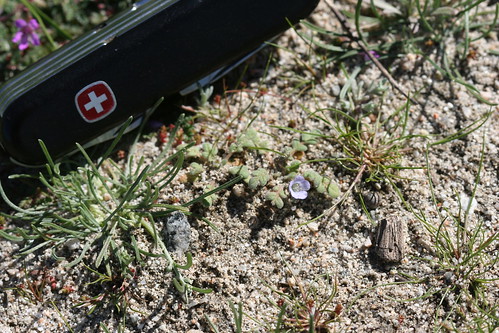
Phacelia stellaris with a swiss army knife for scale
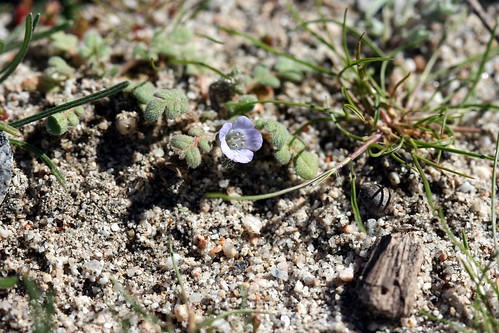
Phacelia stellaris is is a tiny annual herb in the borage or forget-me-not family (Boraginaceae). Its common name is star phacelia which is derived from its latin epithet stellaris, meaning star. I find that name particularly fitting since the plant looks like a little star in the sand when it flowers. This is the first year I have had the privilege to see this species in the field.  For someone who loves belly plants (like me!), this plant is a show stopper! Phacelia stellaris has pale lavender to purple flowers, and a bluish green cast to the leaves.  It gracefully hides itself in the sand and because of this it takes several very skilled botanists with eagle eyes to find them! Its no wonder that there are few recent observations of this species across its range in California.

Phacelia stellaris is considered rare by the California Native Plant Society and is a candidate for listing under the Endangered Species Act by the US Fish and Wildlife Service.  This species is of concern because it is known from just a few location in southern California, US, and in Baja California, MX. Many of the occurrence are considered historic; that is they haven't been seen in over 30 years. In fact many haven't been seen in over 80's years, since the 1920's and 1930's. One population that was recorded to be in the bed of the San Diego River is presumed to have gone extinct because it hasn't been seen since 1882!

Phacelia stellaris in the sand. 
Our goal is to retrace the steps of the botanists who have come before us and find Phacelia stellaris at locations where it was historically known in the US. We've started with the easy ones that have been documented since the year 2000.  So far we have seen it at four locations which has given us a better understanding of its habitat requirements.  I truly hope we can find several if not all of the long lost populations of Phacelia stellaris, and perhaps even document a few that we didn't know about before.