Wednesday, April 2, 2014

In the rainshadow: A flora in the Southern Sierra Nevada Mountains


A desert wash in my study site.
March 2014. Photo by Erika Gardner
I've known since the second grade that I was to be a botanist. Actually, the first time I visited Rancho Santa Ana Botanic Garden (RSABG) was in the second grade for a class field trip. Ever since, I have been obsessed with the garden. It's where I wanted to go on weekends, summer breaks, and any opportunity I could get. It was the closest place to my home that resembled a wilderness and it was where I wanted to be. 
Now that I think about it, I had no clue what a botanist was in the second grade.
I have always enjoyed learning about living organisms, learning about how they function, and observing them in nature. 

Cal Poly Pomona afforded me my long awaited opportunity to study plants. During my sophomore year I landed an internship at RSABG - a 10-week Herbarium Curatorial Assistant position supported by the Getty Multicultural Undergraduate Internship program. I couldn’t believe my luck. At the time, I had no idea as to what a herbarium was but I knew it had something to do with botany and it was at the botanic garden!

One thing led to another as the stars lined up perfectly. I was hired to work part-time in the herbarium while I finished my biology degree at Cal Poly and then moved to full-time work, gaining greater and greater responsibility in the herbarium. Then in 2012, I decided to pursue a Master’s degree in Botany at RSABG. Working in the herbarium had made me realize that there is so much to learn about the floristic diversity of California and I wanted to learn as much as I could by conducting a floristic project.

On the hunt for plants. Documenting diversity.
April 2013. Photo by Phillip Alba
The RSABG Master’s Program allows students to work on and publish a flora of an area in California. Students get to choose the area, collect and identify the plants in that area and synthesize the data. A published flora is then a useful tool to further scientific and public knowledge about plant geography in California via GIS analysis and collections data. 

Now in my second year, I'm working on my Master's thesis project: a botanical survey and inventory of the Kiavah Wilderness in the Scodie Mountains of the Southern Sierra Nevada, Kern County, California. I chose the Scodie Mountains because of my deep admiration and affection for the Sierra Nevada Mountains and the Mojave Desert.

The Kiavah Wilderness is a total of 139 sq. miles and lies in a transition zone between the Mojave Desert and the Sierra Nevada floristic regions. Its plant communities include Joshua Tree Woodland, Riparian Scrub and Mixed Coniferous Forest (juniper, pinyon, oak and pine). Interestingly, the last botanists to make significant collections in this area were Jim Shevock and Barbara Ertter in the 1980s. Many portions of the wilderness have not yet been explored. I'll reach these high-priority "botanical black-holes" via cross-country hiking, exploring and documenting as much of the flora as possible. Using GIS software, my collection localities will be mapped and the data will be served to the Consortium of California Herbaria website.

Driving into the Kiavah Wilderness. Sage Canyon. April 2013
Photo by Erika Gardner
Last year was a challenging time to begin a floristic project. It was an extremely dry year - bone dry. It was frightening to see how the drought could wreak so much havoc on the vegetation and wildlife. While the Scodie Mountains are prime hunting grounds for nesting eagles, I didn't see a single golden eagle. Not a single jackrabbit bolted from under the shrubs. I took as much data as I could - about 367 specimens.

Sage Canyon carpeted with Phacelia fremontii.
March 2014. Photo by Erika Gardner
This year things are looking a lot better in the Kiavah Wilderness for both the plants and animals. After a winter without any significant precipitation, California Governor Jerry Brown declared a drought emergency - something a floristic student does not want to hear. However, things took a slight turn for the better by the end of February when a large storm system swept through the state. The Scodie Mountains received over 2 inches of rain in less than two days! This was a remarkable amount of moisture. On average the Scodies receive about 8 inches annually. I returned to the Wilderness in March and to my surprise many annuals had germinated and were in full flower. It was such an amazing experience to see my project area in all of its glory. It was a breathtaking sight. It was hard to return home - I just wanted to explore every canyon and rock outcrop in the Wilderness. In March I spent 8 full days in the field and collected over 250 specimens. The wildflowers were growing in large swaths of color - blue Gilia, yellow Leptosyne and orange poppies. Even the wildlife appeared to be doing well. I saw many pollinators swarming the Gilia fields, flocks of sage sparrows and pinyon jays, a fair number of jackrabbits and cotton tails and even soaring golden eagles.

Joy England, a fellow Master's student, basking in the poppies
March 2014. Photo by Erika Gardner
Every time I venture into the wilderness I discover plants that I did not see last year or on the previous visit.  It is a very exciting feeling. I'm looking forward to compiling and analyzing my data, but first I have a full field season of collecting ahead of me. In fact I will be featuring specimens that I collect from the Kiavah Wilderness in the upcoming Wildflower Show, April 19th. If you would like to see the plant diversity from my study site please come to the Wildflower Show! I would be delighted to talk with you about the Kiavah Wilderness.


Want to see more of the Kiavah Wilderness? Follow my blog at http://scodies.blogspot.com 

Monday, March 10, 2014

The first thousand of many: digitizing the M.E. Jones collection


Acacia hindsii, collected in Mexico, 1892
Herbarium specimens (pressed plants mounted to paper) are beautiful works of art, but also serve importantly to document the natural world, to aid in plant identification, to further our understanding of plants and plant diversity and to facilitate new discoveries in botany. In my mind, and quite likely for many others, botanical specimens are where science, history, and art intersect. As I sort through specimens of Marcus E. Jones, truly exquisite collections of both botanical and historic significance, I am reminded of this important connection among disciplines.

Marcus E. Jones (1852–1934) was one of the most prominent botanists of the American West. Jones collected thousands of plants, and photographed and recorded detailed notes of the regions he traveled in. Jones’ plant collecting at the turn of the century provided an early comprehensive characterization of the flora of the West; he collected in areas that were poorly known, some of which have since been developed. Jones was also a skilled plant taxonomist who described hundreds of new species, many of which are represented as type specimens (a specimen selected to serve as a reference point when a plant specimen is first named) and are housed in our herbarium at Rancho Santa Ana Botanic Garden (RSABG).


Jessica Chairez, entering specimen records into database
In 1882, outlaw Jesse James was killed by Robert Ford, Thomas Edison created the first string of Christmas tree lights, Robert Koch discovered the germ that causes tuberculosis, and Arizona, Colorado, Utah, New Mexico, Montana, and Idaho, among others, had yet to achieve statehood. 1882 is also the year that Marcus E. Jones took the first of several botanical trips to Baja California, Mexico.

The plant collections and archives from Jones’ trips to Mexico (one in 1882, a second in 1892, and four trips during 1926–1930) are the focus of an ongoing project in the herbarium and library at RSABG: to research and digitize the most important portions of the Jones specimens and archival collections. The herbarium houses an estimated 100,000 specimens collected by M. E. Jones (originally purchased by Pomona College in 1923 and later transferred to RSABG), representing plants from western United States, California, and Baja California, Mexico. In addition to the plant collections, the library houses the M. E. Jones archives, which contain his photographs, field notes, diaries, manuscripts, and correspondence with other important botanists, including Alice Eastwood, Katherine Brandegee, and Philip A. Munz, among others.


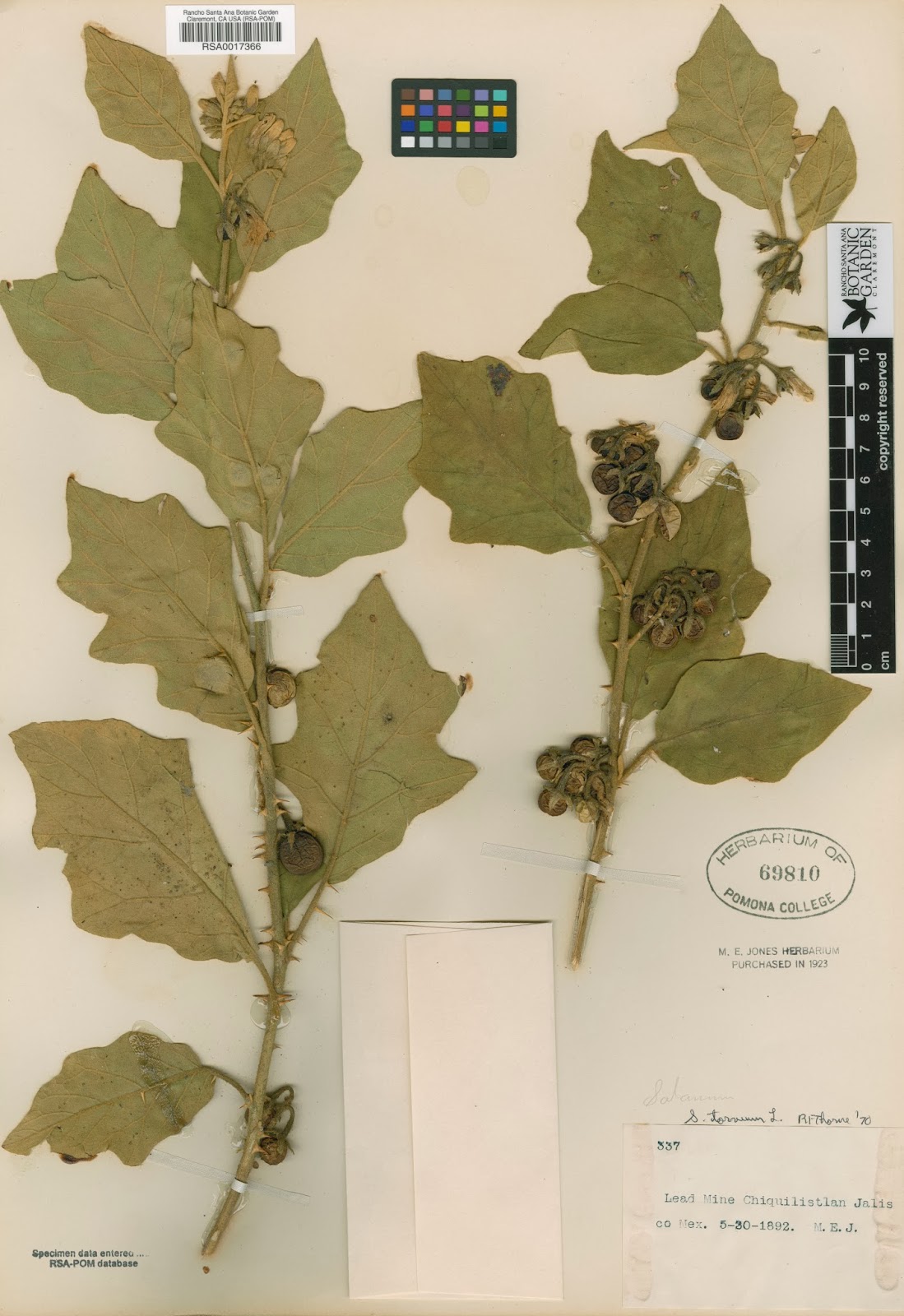
Solanum torreanum, collected in Mexico, 1892
Digitizing Jones’ specimens involves a series of steps: specimens are located and pulled from the main collection in the herbarium; each specimen is barcoded and databased (in which information on the collection label is recorded in our herbarium database); the specimen is then imaged using an inverted scanner (to prevent from having to turn a specimen over). It takes approximately four minutes to produce a high-resolution image of the specimen. To date, we have databased and imaged more than 1000 specimens in the herbarium. The images and data associated with these specimens (metadata) are now available through the Global Plants Initiative through JSTOR, a shared digital online library (http://plants.jstor.org).

In the library, preservation of the Jones collection involves cleaning, labeling, and accessioning the contents of the Jones archives. Glass slides, negatives, and photographs are stored in protective sleeves, and the pages of photo albums are protected with sheets of archival tissue sandwiched between. Each item is accessioned and organized in archival quality boxes. Descriptions and metadata of all archived items are captured in an electronic database. In addition, we have imaged archived objects (such as glass slides and negatives, photographic prints, correspondences, diaries, and notebooks) using similar methods for herbarium specimen imaging.


Rachel Poutasse, preparing a specimen for scanning
Many of our herbarium staff, graduate students, and volunteers at the Garden have been involved in various aspects of the Marcus E. Jones project. Curatorial Assistant Jessica Chairez has largely led the charge, overseeing nearly all aspects of the project, including data entry, imaging specimens, compiling metadata, processing the archives collection, and training students and volunteers. Graduate students Diana Jolles, Forrest Freund, and Manuel Lujan have participated in pulling specimens, databasing, and imaging. Volunteer Robert Swank has assisted with archiving the photographs and photo books. A new addition to the project, volunteer Marilyn Irwin, has recently been trained to image herbarium specimens. The dedicated efforts of staff, students, and volunteers helped to make digitizing the first thousand specimens of Marcus E. Jones collections possible. And we are already well underway of digitizing our second thousand!

For more information about the life of Marcus E. Jones, see:
Ertter, B. 2001. Native California Roses. Discovery of Rosa minutifolia Engelm. “Ensenada Rose.” Accessed at http://ucjeps.berkeley.edu/ina/roses/minutifolia.html

Lenz, L. W. 1986. Marcus E. Jones: Western Geologist, Mining Engineer and Botanist. Rancho Santa Ana Botanic Garden, Claremont, CA.

Rush, E. 2007. Marcus Jones: an outspoken maverick (1852–1934). Fremontia 35: 9–13.


Friday, February 7, 2014

Sky's the limit: alpine plants on a Sierra Nevada sky island

Botany is addictive.  As a kid growing up near the western foothills of the Sierra Nevada mountain range, I took numerous summer camping trips to the forests where I loved trying to identify every kind of tree and wildflower I saw.  I would religiously consult the plant pictures and descriptions in my copy of T. Storer’s Sierra Nevada Natural History, the classic guide for anyone exploring California's most glamorous mountain range. 

Now as a graduate student in the research department at RSABG I am still fascinated with native plants. I am currently working on a floristic inventory of the Rock Creek drainage in Inyo National Forest on the eastern side of the Sierra Nevada, about 50 air miles southeast of Yosemite National Park.  On a topographic map the upper Rock Creek watershed appears as an eggplant-shaped hollow about 30 sq. miles in area, surrounded by steep granite ridges and peaks, many reaching 12000 feet and higher.  In the course of my research I have found there is little documentation about the biodiversity of the high mountain summits around Rock Creek, which are physically challenging to reach.

Rock Creek, Inyo NF
I'm inspired by the work of botanists whose insatiable curiosity has led them on searches for plants in wild remote places.  Long before before I was born, an accomplished botanist named John Thomas Howell made a challenging climb up a high mountain in the Rock Creek drainage that had no record of previous botanical exploration.  Howell—who earlier in his career had been the first botanist hired on staff at RSABG—described the flat-topped mountain as a “sky island” looming high above Rock Creek Lake.  It had no geographic name, so he called it Mono Mesa.  He originally saw it while on a botanical collecting trip through Mono Pass.  Howell climbed to the top of Mono Mesa in July 1946, collected representative samples of as many different plants as he could find, and shortly thereafter published a list of species.  He found 73 taxa, which he considered an impressive number for a high summit with ¼ sq. mile of land area.  Howell recounted his fascination with the barren yet beautiful landscape he described as a “velvet-textured monotony.”  He wrote that Mono Mesa was unusual, that unlike the surrounding jagged ridge tops it had never been glaciated, never changed by eroding effects of melting and moving ice.

Sky island: Mono Mesa's flat surface visible from the Mono Pass area
Sixty seven years later in summer 2013 I stood at our base camp at Summit Lake near the top of Mono Pass, impressed by the monumental view of Mono Mesa rising into the sky two miles to the north.  I contemplated my quest to resurvey the mesa, which had been many months in planning, preparation and no small measure of uncertainty.  Local folks in the Rock Creek valley had assured me that a day hike to the summit (12260 ft.) was very doable but there seemed no clear consensus on which route was best and no established trail to follow. 

We set out from camp the morning of July 12, a two-person team consisting of myself and RSABG colleague Travis Columbus.   It took us several hours to make our way cautiously along a narrow knife ridge of piled boulders leading up to the mesa edge and after many heart-pounding moments negotiating our way around gigantic boulders and sheer drop-offs we arrived at the summit in early afternoon.  I spent the remainder of the day collecting plant samples, recording GPS data and taking field notes as we surveyed the wide plateau.

Sky pilot (Polemonium eximium) is endemic to the Sierra Nevada
I was struck by the barren expanse of sandy rocky plain, practically devoid of trees and shrubs except for a few small, scraggly whitebark pines (Pinus albicaulis) clinging to the south rim.  A closer inspection revealed an assortment of small colorful plants with cushion- or mat-like growth forms, hugging the ground or sheltering under lichen-covered rocks as if to take refuge from the unforgiving alpine environment.  Plants have to be tough survivors up here.  Many species I happily observed still thriving on Mono Mesa decades after Howell documented them, including Davidson’s penstemon (Penstemon davidsonii), alpine gold (Hulsea algida), dwarf alpine Indian paintbrush (Castilleja nana) and sky pilot (Polemonium eximium): arguably the flashiest most charismatic alpine plant that only grows in the Sierra Nevada.

Alpine gold (Hulsea algida)
My curiosity to resurvey the mesa was especially keen because of the potential impacts of climate change. Warming temperatures are a significant threat to alpine plant communities especially on the highest summits where plants cannot disperse any higher to find cooler microclimates. Perhaps there are species still unknown to science persisting on Mono Mesa and atop other Sierra sky islands where the chance of discovering them is getting slimmer as the climate warms.  It was an unforgettable experience seeing the wonderful flora of Mono Mesa; hopefully my ongoing work to identify the plants I collected there will contribute to understanding life on these magnificent islands in the sky.

Friday, January 10, 2014

Upcoming field expedition for triple ribbed milkvetch

Astragalus tricarinatus on a cliff face near Mission Creek 
This coming spring the Conservation Program has an exciting new project that will be undertaken in some remote and underexplored sections of our California deserts to look for a federally endangered plant called Astragalus tricarinatus, or triple ribbed milkvetch as its known by its common name. This plant grows on an unusual geological substrate called “distressed granite” that is formed along the San Andreas Fault line where it bends and twists from its north/south trending direction to a more east to west trending direction in the Coachella Valley area. This Astragalus is a California endemic which means it is found nowhere else and is also considered a narrow endemic as its found in a relatively small area.

"distressed granite" outcroppings along the Pacific Coast Trail
The Conservation program had the great opportunity in the spring of 2011 to do surveys for Astragalus tricarinatus in the Whitewater and Mission Creek area where we visited many historic locations, found new undocumented populations, and collected a great deal of habitat information for this unusual plant, however a number of questions where left unanswered concerning some very old collections and literary references to this species being in other areas much more to the east. One of these curios historic records was left by a plant taxonomist named R. C. Barneby who was the leading expert on this genus in the 20th century. In his notes on Astragalus tricarinatus he wrote that it occurs in the Orocopia Mountains in Riverside County. While the Orocopia Mountains are geologically quite diverse, and in the path of the San Andreas Fault, they are still around 40 miles further east than the general area where Astragalus tricarinatus is found. There was no physical specimen of A. tricarinatus that we could locate from this range so all we have is Barnaby’s word that it grows there. While Barneby’s expert knowledge holds a lot of weight it is also important to have a physical specimen in a herbarium that can be visited and studied and this is one of the main goals for this project we will be undertaking, to locate A. tricarinatus in the Orocopias, asses population status and population numbers and collect as much information on this endangered plant that we possibly can.


Spencer's voucher from Chuckwalla Mtns (Harvard image)
One herbarium specimen we do have to go on, that has also been one of question, is a collection from 1921 from Mary Spencer that was apparently collected even further east in the Chuckwalla Mountains. The Chuckwalla Mountains are pretty far from the San Andreas Fault, and while they are made up of granite they don’t appear to have the “distressed granite” that Astragalus tricarinatus prefers. So this specimen brings up many more questions: can A . tricarinatus grow on other geological substrates besides “distressed granite”? There has been a good deal of visitation by botanists to this range in the past 100 years, so is it possible that at one time A. tricarinatus did occur here but no longer does? Was this perhaps a “waif” population? And while Mary Spencer wrote on her collection label “Chuckwalla Mountains” could she have been referring to a larger area that would also include the Orocopia Mountains? The only thing we know for sure right now is that the plant collected by Mary Spencer is definitely A. tricarinatus, we have this very important herbarium record that we can visit and reference, but the big question is: where exactly did she collect it? Perhaps she found the same population that R. C. Barnaby writes of. These are all questions we are hoping to answer this coming spring.