|
| Rafinesquia neomexicana (desert chicory) |
In my earliest years documenting plants as a botanist, I was fortunate enough to
experience several consecutive wet winters including the 2004-2005 El Niño
winter and the spectacular display of wildflowers that followed. I thought I
could look forward to California’s seasonal show every spring but, unfortunately,
I soon learned that spring in California is not an automatic wildflower
wonderland and that these displays are the exception rather than the rule.
However this past winter our region was forecast to experience one of the
strongest El Niño events on record following four years of severe drought. El
Niño alone doesn’t necessarily make for a stormy winter, but above average
rainfall is an exciting prospect for our state which has suffered from extreme
drought. It is also exciting for the staff at RSABG because of the exceptional
wildflower displays that follow and the important work that will be carried out
as a consequence.
 |
| Mohavea breviflora (golden desert snapdragon) |
Showy spring wildflower displays in California are composed
mostly of annual plants. A large percentage of California native plant species
are annuals, meaning that they complete their life cycle from seed to seedling
to a reproductive flowering plant and back to seed in less than one year. Most
annuals require sufficient rainfall to germinate and in years of drought they
are sparse or can be totally absent. A wet winter provides an opportunity to
document these drought evading plants and learn more about their natural
history, abundance, and distribution. Importantly, large shows of flowers of
many species also may mean abundant seed production, providing out staff with
the opportunity to collect seed for conservation and research.
You may have learned about RSABG’s important seed conservation program and the ambitious collaborative project now under way. California Plant Rescue (CaPR), a collaborative effort
to save seeds of all California wild plant species for future generations. The
CaPR project is currently focused on securing seed of the rarest, most
threatened and endangered plants in California and is therefore critical to
long-term plant conservation. Seed banks ultimately store genetic diversity and
serve as a back system for natural populations in the event of catastrophic
loss. In addition these collections make important contributions to research to
expand knowledge of our native flora. As you can imagine, securing seed in a
time of drought can be challenging no matter how ambitious the project!
 |
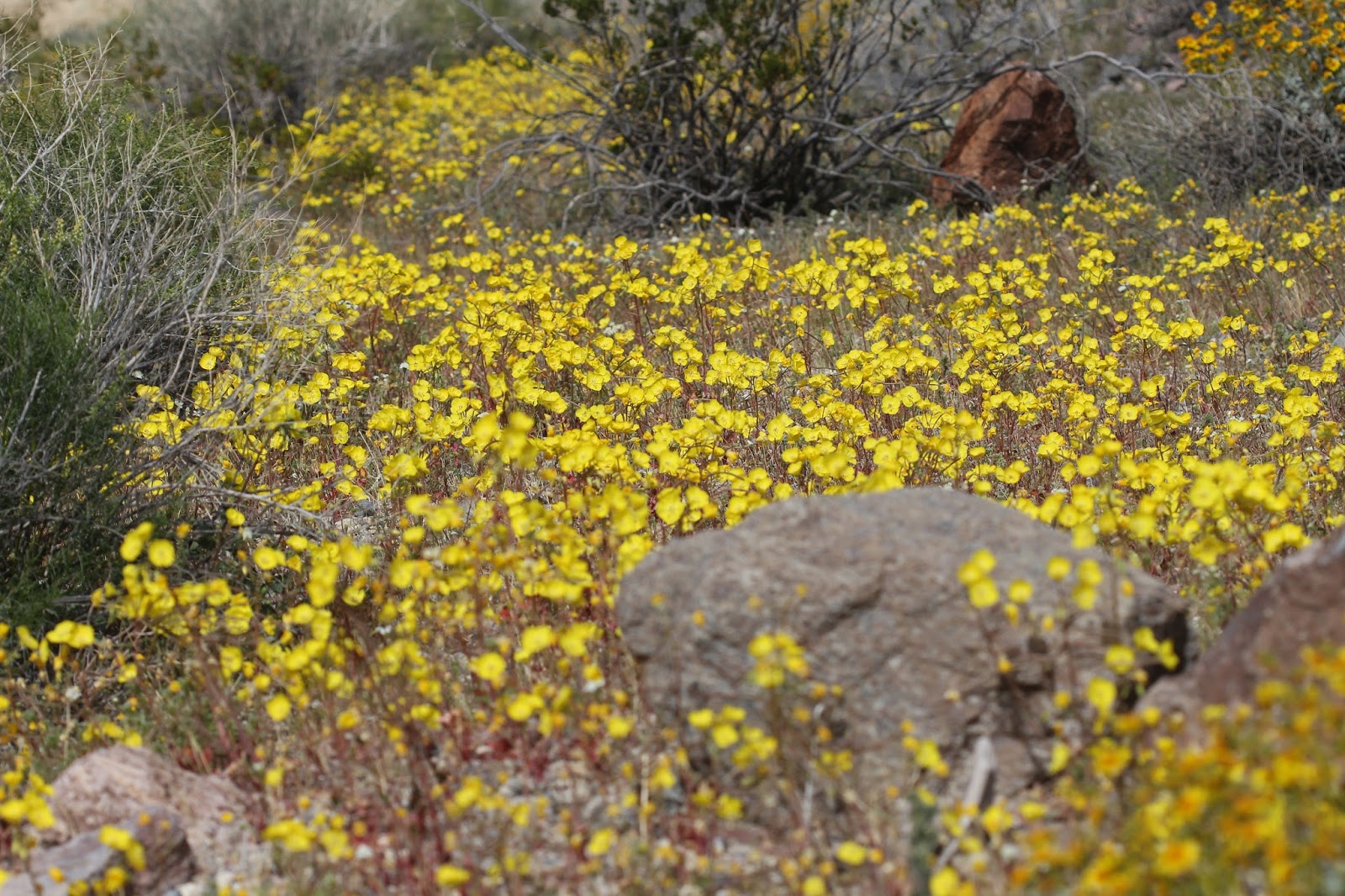
| Chylismia brevipes (yellow cups) |
You can
be assured that RSABG botanists have been watching the weather reports to
identify the best locations for collecting seeds. One of our target areas is the Death Valley region which has experienced a "super bloom" this past spring due to a large storm event in October. We hope the rain will also
trigger germination of annual plant species that are rare and seldom seen;
these are in special need of seed banking to further conservation.
A floriferous spring is not only important to ongoing seed banking efforts, but
would also be valuable for other Garden collections such as our herbarium.
Following the last El Niño event in 2005, RSABG staff set out on several
botanical forays to document the flora and add important collections to our
herbarium. We conducted forays in some of the areas that showed the best and
most diverse blooms, especially in the Mojave Desert. Research and conservation
staff traveled to the northern Mojave Desert in Inyo County, on the outskirts
of Death Valley National Park to places like the Ibex Hills, Amargosa River,
Avawatz Mountains and Chicago Valley. We also took several trips to Riverside
County in the Palen Mountains, and to San Bernardino County to investigate the
Marble and Rodman Mountains. That year (2005) RSABG staff brought home more
than 2000 botanical specimens to add to our herbarium and to further
documentation of California’s flora. This spring we hope to do the same, or
even more!
 |
| Diplacus fremontii (Fremont's monkeyflower) |
Many of the botanists at RSABG watch the weather as avidly as we
examine plants under a dissecting scope. Climate and weather events are
intimately tied to the time at which plants bloom and their abundance on the
landscape. Knowing that these weather events can be few and far between, we
need to make the most of our resources to do the important work that is needed to
advance understanding and conservation of California’s native plants. The
spring season is short and fleeting so we prepare well in advance to ensure
that we are able to make the most of our time. Our work is carried out in a
coordinated effort between multiple departments at the Garden and staff will
travel far and wide to make collections for the herbarium, seed bank and living
collection. Once back home these collections will continue to serve our mission
to promote research, horticulture, education, and conservation of California’s
native plants long into the future.