Showing posts with label flora. Show all posts

Tuesday, April 12, 2016

A Wildflower Wonderland

Rafinesquia neomexicana (desert chicory)
In my earliest years documenting plants as a botanist, I was fortunate enough to experience several consecutive wet winters including the 2004-2005 El Niño winter and the spectacular display of wildflowers that followed. I thought I could look forward to California’s seasonal show every spring but, unfortunately, I soon learned that spring in California is not an automatic wildflower wonderland and that these displays are the exception rather than the rule. However this past winter our region was forecast to experience one of the strongest El Niño events on record following four years of severe drought. El Niño alone doesn’t necessarily make for a stormy winter, but above average rainfall is an exciting prospect for our state which has suffered from extreme drought. It is also exciting for the staff at RSABG because of the exceptional wildflower displays that follow and the important work that will be carried out as a consequence.

Mohavea breviflora (golden desert snapdragon)
Showy spring wildflower displays in California are composed mostly of annual plants. A large percentage of California native plant species are annuals, meaning that they complete their life cycle from seed to seedling to a reproductive flowering plant and back to seed in less than one year. Most annuals require sufficient rainfall to germinate and in years of drought they are sparse or can be totally absent. A wet winter provides an opportunity to document these drought evading plants and learn more about their natural history, abundance, and distribution. Importantly, large shows of flowers of many species also may mean abundant seed production, providing out staff with the opportunity to collect seed for conservation and research.

You may have learned about RSABG’s important seed conservation program and the ambitious collaborative project now under way. California Plant Rescue (CaPR), a collaborative effort to save seeds of all California wild plant species for future generations. The CaPR project is currently focused on securing seed of the rarest, most threatened and endangered plants in California and is therefore critical to long-term plant conservation. Seed banks ultimately store genetic diversity and serve as a back system for natural populations in the event of catastrophic loss. In addition these collections make important contributions to research to expand knowledge of our native flora. As you can imagine, securing seed in a time of drought can be challenging no matter how ambitious the project!
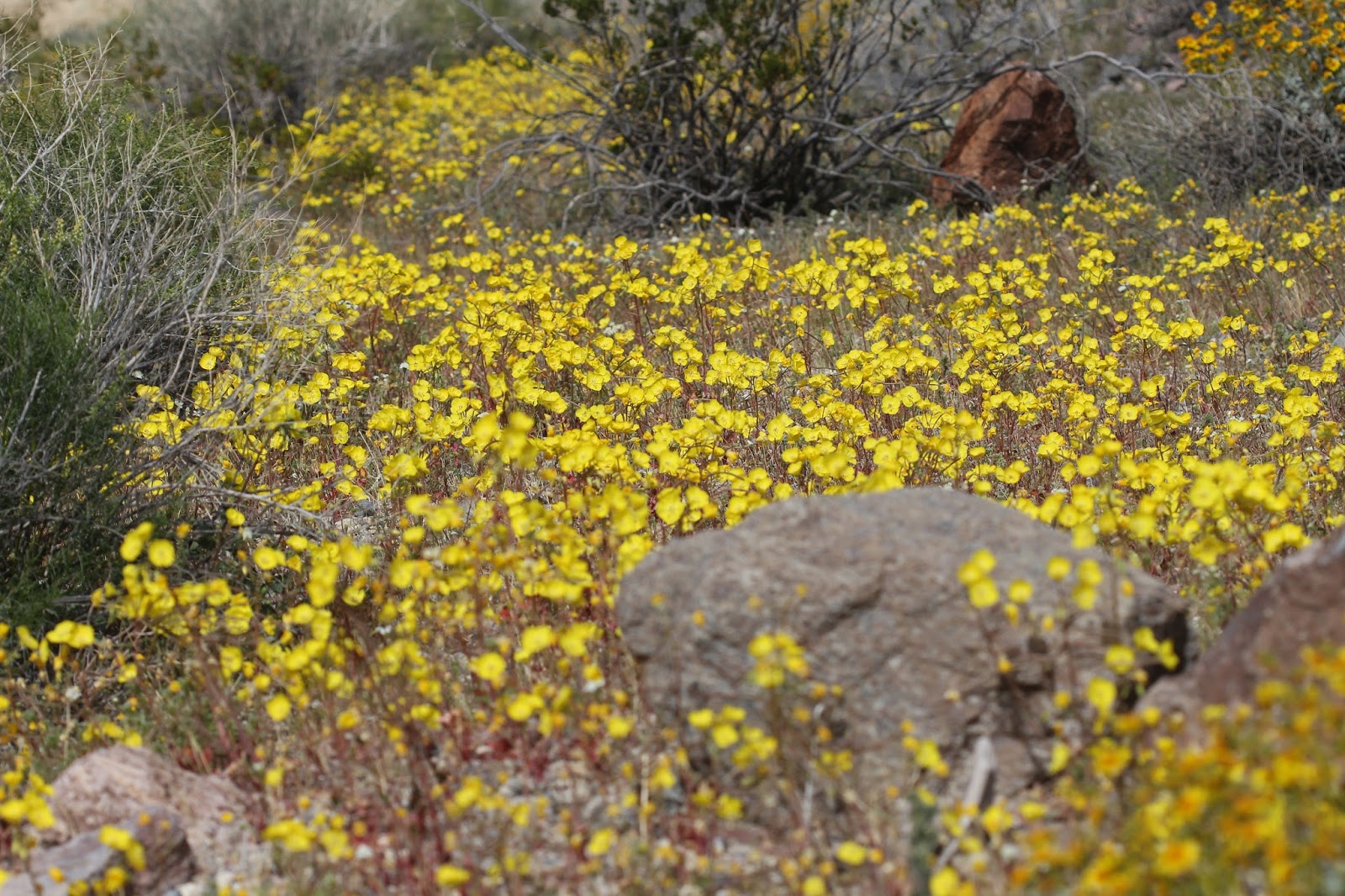
Chylismia brevipes (yellow cups)

You can be assured that RSABG botanists have been watching the weather reports to identify the best locations for collecting seeds. One of our target areas is the Death Valley region which has experienced a "super bloom" this past spring due to a large storm event in October. We hope the rain will also trigger germination of annual plant species that are rare and seldom seen; these are in special need of seed banking to further conservation. A floriferous spring is not only important to ongoing seed banking efforts, but would also be valuable for other Garden collections such as our herbarium. Following the last El Niño event in 2005, RSABG staff set out on several botanical forays to document the flora and add important collections to our herbarium. We conducted forays in some of the areas that showed the best and most diverse blooms, especially in the Mojave Desert. Research and conservation staff traveled to the northern Mojave Desert in Inyo County, on the outskirts of Death Valley National Park to places like the Ibex Hills, Amargosa River, Avawatz Mountains and Chicago Valley. We also took several trips to Riverside County in the Palen Mountains, and to San Bernardino County to investigate the Marble and Rodman Mountains. That year (2005) RSABG staff brought home more than 2000 botanical specimens to add to our herbarium and to further documentation of California’s flora. This spring we hope to do the same, or even more!
Diplacus fremontii (Fremont's monkeyflower)

 Many of the botanists at RSABG watch the weather as avidly as we examine plants under a dissecting scope. Climate and weather events are intimately tied to the time at which plants bloom and their abundance on the landscape. Knowing that these weather events can be few and far between, we need to make the most of our resources to do the important work that is needed to advance understanding and conservation of California’s native plants. The spring season is short and fleeting so we prepare well in advance to ensure that we are able to make the most of our time. Our work is carried out in a coordinated effort between multiple departments at the Garden and staff will travel far and wide to make collections for the herbarium, seed bank and living collection. Once back home these collections will continue to serve our mission to promote research, horticulture, education, and conservation of California’s native plants long into the future.

Friday, February 7, 2014

Sky's the limit: alpine plants on a Sierra Nevada sky island

Botany is addictive.  As a kid growing up near the western foothills of the Sierra Nevada mountain range, I took numerous summer camping trips to the forests where I loved trying to identify every kind of tree and wildflower I saw.  I would religiously consult the plant pictures and descriptions in my copy of T. Storer’s Sierra Nevada Natural History, the classic guide for anyone exploring California's most glamorous mountain range. 

Now as a graduate student in the research department at RSABG I am still fascinated with native plants. I am currently working on a floristic inventory of the Rock Creek drainage in Inyo National Forest on the eastern side of the Sierra Nevada, about 50 air miles southeast of Yosemite National Park.  On a topographic map the upper Rock Creek watershed appears as an eggplant-shaped hollow about 30 sq. miles in area, surrounded by steep granite ridges and peaks, many reaching 12000 feet and higher.  In the course of my research I have found there is little documentation about the biodiversity of the high mountain summits around Rock Creek, which are physically challenging to reach.

Rock Creek, Inyo NF
I'm inspired by the work of botanists whose insatiable curiosity has led them on searches for plants in wild remote places.  Long before before I was born, an accomplished botanist named John Thomas Howell made a challenging climb up a high mountain in the Rock Creek drainage that had no record of previous botanical exploration.  Howell—who earlier in his career had been the first botanist hired on staff at RSABG—described the flat-topped mountain as a “sky island” looming high above Rock Creek Lake.  It had no geographic name, so he called it Mono Mesa.  He originally saw it while on a botanical collecting trip through Mono Pass.  Howell climbed to the top of Mono Mesa in July 1946, collected representative samples of as many different plants as he could find, and shortly thereafter published a list of species.  He found 73 taxa, which he considered an impressive number for a high summit with ¼ sq. mile of land area.  Howell recounted his fascination with the barren yet beautiful landscape he described as a “velvet-textured monotony.”  He wrote that Mono Mesa was unusual, that unlike the surrounding jagged ridge tops it had never been glaciated, never changed by eroding effects of melting and moving ice.

Sky island: Mono Mesa's flat surface visible from the Mono Pass area
Sixty seven years later in summer 2013 I stood at our base camp at Summit Lake near the top of Mono Pass, impressed by the monumental view of Mono Mesa rising into the sky two miles to the north.  I contemplated my quest to resurvey the mesa, which had been many months in planning, preparation and no small measure of uncertainty.  Local folks in the Rock Creek valley had assured me that a day hike to the summit (12260 ft.) was very doable but there seemed no clear consensus on which route was best and no established trail to follow. 

We set out from camp the morning of July 12, a two-person team consisting of myself and RSABG colleague Travis Columbus.   It took us several hours to make our way cautiously along a narrow knife ridge of piled boulders leading up to the mesa edge and after many heart-pounding moments negotiating our way around gigantic boulders and sheer drop-offs we arrived at the summit in early afternoon.  I spent the remainder of the day collecting plant samples, recording GPS data and taking field notes as we surveyed the wide plateau.

Sky pilot (Polemonium eximium) is endemic to the Sierra Nevada
I was struck by the barren expanse of sandy rocky plain, practically devoid of trees and shrubs except for a few small, scraggly whitebark pines (Pinus albicaulis) clinging to the south rim.  A closer inspection revealed an assortment of small colorful plants with cushion- or mat-like growth forms, hugging the ground or sheltering under lichen-covered rocks as if to take refuge from the unforgiving alpine environment.  Plants have to be tough survivors up here.  Many species I happily observed still thriving on Mono Mesa decades after Howell documented them, including Davidson’s penstemon (Penstemon davidsonii), alpine gold (Hulsea algida), dwarf alpine Indian paintbrush (Castilleja nana) and sky pilot (Polemonium eximium): arguably the flashiest most charismatic alpine plant that only grows in the Sierra Nevada.

Alpine gold (Hulsea algida)
My curiosity to resurvey the mesa was especially keen because of the potential impacts of climate change. Warming temperatures are a significant threat to alpine plant communities especially on the highest summits where plants cannot disperse any higher to find cooler microclimates. Perhaps there are species still unknown to science persisting on Mono Mesa and atop other Sierra sky islands where the chance of discovering them is getting slimmer as the climate warms.  It was an unforgettable experience seeing the wonderful flora of Mono Mesa; hopefully my ongoing work to identify the plants I collected there will contribute to understanding life on these magnificent islands in the sky.

Thursday, October 3, 2013

Summer showers bring fall flowers


Bighorn Mountain Wilderness near Ruby Canyon
Spring time is the season when I usually get reacquainted with all my old flowering friends, go on wildflower walks, and spend lots of time doing what I love best; looking for plants! Who would have thought that late summer and fall could be just as amazing and floriferous as the spring season? There are currently billowing fields of flowers in California’s desert that resulted from several significant storms this past summer in August and September. This year I have been able to take several field trips to view the spectacle of desert flowers at a site called the Bighorn Mountain Wilderness.

The Bighorn Mountain Wilderness is the subject of an ongoing RSABG research project to inventory and create a checklist of all the plants that occur in the area with special attention to documenting rare and invasive plants. The Wilderness is 38,502 acres and set back against the north side the San Bernardino Mountains in San Bernardino County, California. Our partners on this project are the Bureau of Land Management and the San Bernardino National Forest who both manage portions of the wilderness.

Fields of brightly covered chinchweed blanket the floor
Last week on 26 September 2013, 12 staff and students from RSABG set out to document the spectacular fall bloom.The area is difficult to access without a four-wheel drive vehicle; therefore few botanists have documented plants in the Wilderness prior to our study. After traveling one hour via dirt road and one flat tire, we got to our survey sites and found an abundance of summer annuals. We also found perennials that normally bloom in the spring, but have perked up in response to the summer rain.  

The summer annuals that predominate and form carpets in the Bighorn Mountain Wilderness are: fringed amaranth (Amaranthus fimbriatus), needle grama (Bouteloua aristidoides), six weeks grama (Bouteloua barbata), Sonoran sandmat (Euphorbia micromeria), Yuma sandmat (Euphorbia setiloba), and chinchweed (Pectis papposa).

Other less common annuals include windmills (Allionia incarnata) and spinderling (Boerhavia triquetra var. intermedia).  Shrubs in the sunflower family such as wedgelead goldenbush (Ericamerica cuneata), rubber rabbitbrush (Ericameria nauseosa), round-leaf rabbitbrush (Ericameria teritifolia), and scale broom (Lepidospartum squamatum) are approaching full flower and create a haze of yellow across the landscape.

Mirabilis (four o'clock) in bloom in September 2013
If you have a chance to get out and see this spectacular bloom I would hightly recommend it.  Swaths of blooming plants can be seen just outside of the Bighorn Mountain Wilderness, north of Yucca Valley near the town of Landers. There in Johnson Valley you will find fields of chinchweed and spiny senna (Senna armata). There are also several other locations to see the unusual green cast in desert.  If you head out along I-10 towards Desert Center you will find octotillo (Fouquieria splendens), pallo verde (Parkinsonia florida), and ironwood (Olneya tesota) lush and green with some plants in flower and fields of gramma grass (Bouteloua sp.). 

Stay tuned to our website for updates on our progress and findings in the Bighorn Mountain Wilderness and visit our photo album to see more.  The area is an interesting transition zone between the Mojave and Sonoran deserts and the interior mountains of southern California. Over the course of our study we are sure to have many interesting discoveries that will enhance our knowledge of California’s diverse flora.