Showing posts with label Mojave. Show all posts

Tuesday, April 12, 2016

A Wildflower Wonderland

Rafinesquia neomexicana (desert chicory)
In my earliest years documenting plants as a botanist, I was fortunate enough to experience several consecutive wet winters including the 2004-2005 El Niño winter and the spectacular display of wildflowers that followed. I thought I could look forward to California’s seasonal show every spring but, unfortunately, I soon learned that spring in California is not an automatic wildflower wonderland and that these displays are the exception rather than the rule. However this past winter our region was forecast to experience one of the strongest El Niño events on record following four years of severe drought. El Niño alone doesn’t necessarily make for a stormy winter, but above average rainfall is an exciting prospect for our state which has suffered from extreme drought. It is also exciting for the staff at RSABG because of the exceptional wildflower displays that follow and the important work that will be carried out as a consequence.

Mohavea breviflora (golden desert snapdragon)
Showy spring wildflower displays in California are composed mostly of annual plants. A large percentage of California native plant species are annuals, meaning that they complete their life cycle from seed to seedling to a reproductive flowering plant and back to seed in less than one year. Most annuals require sufficient rainfall to germinate and in years of drought they are sparse or can be totally absent. A wet winter provides an opportunity to document these drought evading plants and learn more about their natural history, abundance, and distribution. Importantly, large shows of flowers of many species also may mean abundant seed production, providing out staff with the opportunity to collect seed for conservation and research.

You may have learned about RSABG’s important seed conservation program and the ambitious collaborative project now under way. California Plant Rescue (CaPR), a collaborative effort to save seeds of all California wild plant species for future generations. The CaPR project is currently focused on securing seed of the rarest, most threatened and endangered plants in California and is therefore critical to long-term plant conservation. Seed banks ultimately store genetic diversity and serve as a back system for natural populations in the event of catastrophic loss. In addition these collections make important contributions to research to expand knowledge of our native flora. As you can imagine, securing seed in a time of drought can be challenging no matter how ambitious the project!
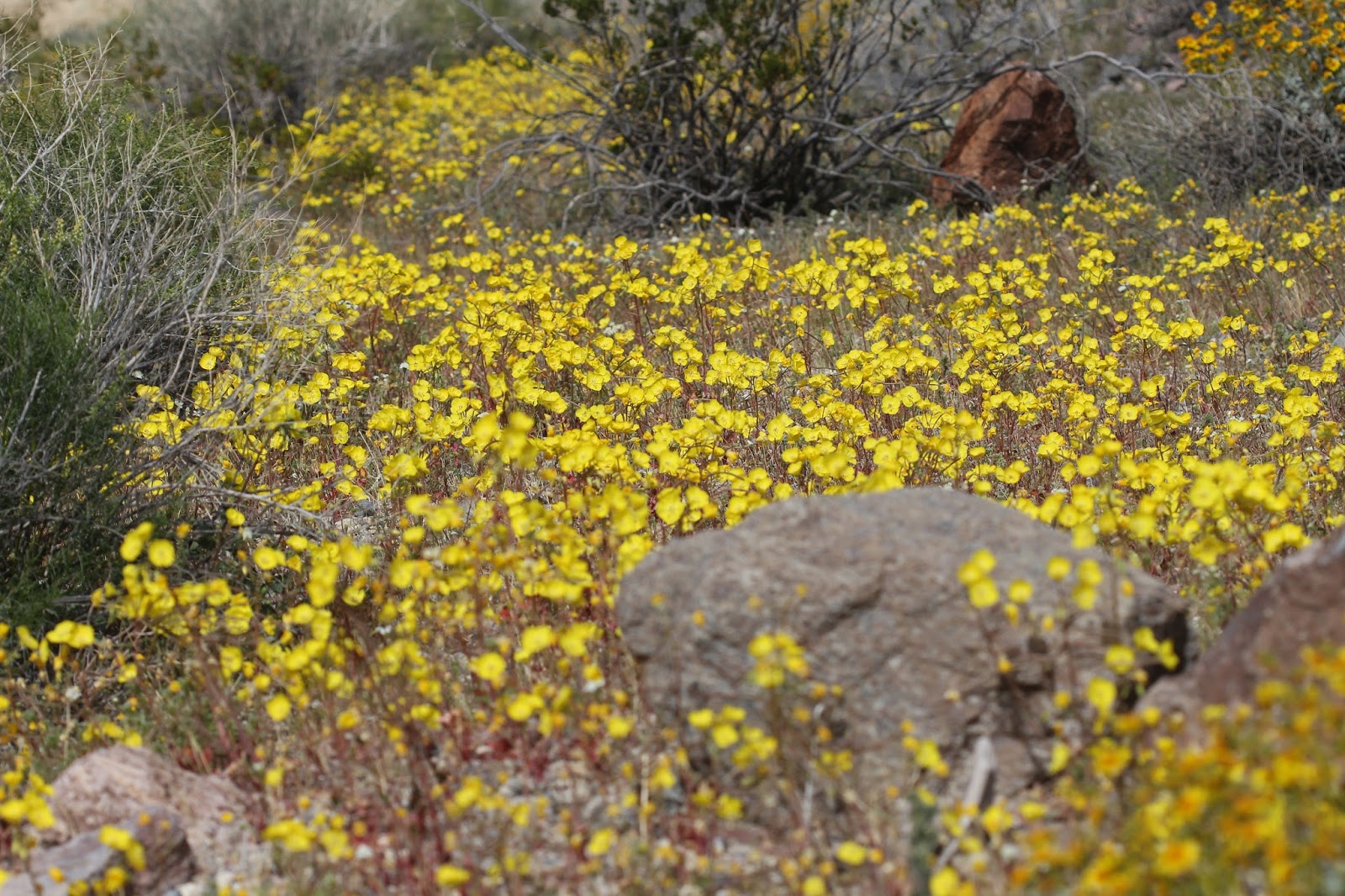
Chylismia brevipes (yellow cups)

You can be assured that RSABG botanists have been watching the weather reports to identify the best locations for collecting seeds. One of our target areas is the Death Valley region which has experienced a "super bloom" this past spring due to a large storm event in October. We hope the rain will also trigger germination of annual plant species that are rare and seldom seen; these are in special need of seed banking to further conservation. A floriferous spring is not only important to ongoing seed banking efforts, but would also be valuable for other Garden collections such as our herbarium. Following the last El Niño event in 2005, RSABG staff set out on several botanical forays to document the flora and add important collections to our herbarium. We conducted forays in some of the areas that showed the best and most diverse blooms, especially in the Mojave Desert. Research and conservation staff traveled to the northern Mojave Desert in Inyo County, on the outskirts of Death Valley National Park to places like the Ibex Hills, Amargosa River, Avawatz Mountains and Chicago Valley. We also took several trips to Riverside County in the Palen Mountains, and to San Bernardino County to investigate the Marble and Rodman Mountains. That year (2005) RSABG staff brought home more than 2000 botanical specimens to add to our herbarium and to further documentation of California’s flora. This spring we hope to do the same, or even more!
Diplacus fremontii (Fremont's monkeyflower)

 Many of the botanists at RSABG watch the weather as avidly as we examine plants under a dissecting scope. Climate and weather events are intimately tied to the time at which plants bloom and their abundance on the landscape. Knowing that these weather events can be few and far between, we need to make the most of our resources to do the important work that is needed to advance understanding and conservation of California’s native plants. The spring season is short and fleeting so we prepare well in advance to ensure that we are able to make the most of our time. Our work is carried out in a coordinated effort between multiple departments at the Garden and staff will travel far and wide to make collections for the herbarium, seed bank and living collection. Once back home these collections will continue to serve our mission to promote research, horticulture, education, and conservation of California’s native plants long into the future.

Wednesday, December 16, 2015

Field Work in the Mojave Sky Islands


As the holidays approach, some of us will be decorating our homes with a tree native to mountains of western North America, the White fir (Abies concolor). This species is fairly common throughout the Rockies, Cascades and Sierra Nevada Mountain Ranges. It can also be found in much more unusual locations, including the mountains of the eastern Mojave Desert.

If you’ve been to Hawaii and have seen the unique native plants that grow there, you probably know that isolated islands in the middle of the ocean often harbor unique species and ecosystems. A similar effect happens in the mainland southwestern US, with high mountains ‘islands’ surrounded by an ‘ocean’ of desert. These places have been dubbed sky islands, and harbor unique ecosystems. These ecosystems often contain endemic species, meaning that they can only be found in these isolated areas. Equally interesting, sky islands also often contain disjunct populations and relict species.  Disjunct population is a term used to describe populations of species that occur far outside of their normal range.  A relict species was more common on the landscape in the past, but due to a changing climate it is now restricted to a very small area. 

Three mountain ranges in the eastern Mojave Desert within California are considered sky islands; the Kingston Mountains, The Clark Mountains, and The New York Mountains. These ranges all rise above 7000 ft. and contain ecosystems that exist nowhere else in the surrounding lower elevation desert.  This fall we took a trip to visit these sky islands and assess the disjunct, relict populations of white fir which occur in the mountains.  

The Kingston Mountains, a Mojave Desert sky island

The populations of white fir in the high elevation mountains of Mojave Desert are part of relict ecosystems which supports patches of coastal vegetation, remaining from a wetter past in the west. A number of plants which are more commonly found in the areas of California west of the mountains also have disjunct populations here. These include coffee berry (Rhamnus californica) and Mexican manzanita (Arctostaphylos pungens). These plants and other’s such as narrow leaved yerba santa (Eriodicyton angustifolium) harken back to an era when much larger areas of the southwest looked more similar to the coastal charparral vegetation that we see in California today. 

The main focus of our trip was to scout the white fir populations in the hopes that we can collect seeds next season and to record detailed information on their health. Occurring in these extreme conditions, and living a relatively long life, these trees can provide a great study system to see how climate change is affecting the mountains. A major concern is that climate change will increase the temperature of these areas and literally push the white fir, and the many other unique species that are adapted to this cooler habitat off of the top of the mountain and into oblivion.  

During our trip, we visited all three of these ranges, but due to time constraints were only able to hike to the population in the New York Mountains. Part of the challenge of working in these areas is their remoteness. They occur at the tops of rugged mountains far from any trails or roads. On our day in the New York Mountains we were joined on in the field on that day by Andrew Kaiser of the Mojave National Preserve. After a challenging hike up the steep southern face, we made it to the main ridge. The views were incredible, but as we arrived and spent some time looking, but did not see any of the large and obvious trees. 

After about an hour of searching among the treacherously steep slopes, we finally saw a large white fir crown rising above the granite boulders. We spent the next several hours taking detailed notes, GPS data and photos. In total, we counted 31 trees, the exact number that was recorded by a team who visited the population in the late 70s, which included the late RSABG herbarium curator emeritus Robert Thorne.  This, plus the fact that found plants ranging from a foot tall to 60 feet was an encouraging sign that the population is not in obvious decline. In 2016, we hope to return to this population, along with the populations in the Kingston and Clark mountains, to do more monitoring, and hopefully make a collection of seeds for the RSABG seed bank. 
A young white fir specimen in the New York Mountains is an encouraging sign that the population will persist into the future

Looking up the steep northern face of the New York Mountains at a stand of white fir

 The sky islands of the Mojave are one of the hidden treasures that exist in the California desert. With nowhere to migrate to if conditions change, a warming climate is especially threatening to the plants and animals of these isolated areas. We hope that in the coming field season, we can gather more data on these special places to help to develop a better sense of how climate change will affect the Mojave Desert Mountains.